

“We help children with developmental challenges move, learn, and communicate to become more confident, independent and live their best lives!”
What is Developmental Coordination Disorder?
Children with Developmental Coordination Disorder (DCD) are not simply clumsy. DCD is a motor skills disorder that affects approximately five to six percent of all school-aged children. DCD has been described in many ways over the years, including dyspraxia, minimal brain dysfunction, and clumsy child syndrome. The medical community has chosen to use the term DCD as the preferred diagnostic term.
DCD occurs when a delay in the development of motor skills, or difficulty coordinating movements, results in a child being unable to perform common everyday tasks. They often have difficulty keeping up with their peers during gross motor play, have frequent falls, and have a hard time doing daily skills, such as zipping and tying shoe laces.
If your child is struggling with developmental coordination disorder, physical therapy can make a significant difference in their daily life. At Kid PT in Raritan, NJ, our skilled pediatric therapists are here to help your child build the motor skills and confidence they need to thrive. From improving coordination to enhancing their ability to perform everyday tasks, we are committed to supporting your child’s growth, confidence and independence. Contact us today to schedule a consultation and take the first step toward helping your child achieve their full potential!

Ongoing Challenges for Children with DCD
The biggest challenge is often with learning a new movement-based skill, which is a challenge that is experienced throughout childhood. These children are often labeled as lazy (read more about how NOT lazy these kids are here!). They’re often told that if they would just try harder they could do it. In the past, it was often assumed that children would outgrow these challenges, but research has demonstrated that children with coordination problems do not simply outgrow these problems.
In fact, these children are at greater risk for being sedentary and less healthy as adults than their peers. These children are also at greater risk for mental health problems.
We cannot risk overlooking the struggles of these children.
There is too much at risk for their futures!
The Importance of Foundational Movement Skills
Children with DCD are constant victims of imperfect practice. These children blend in with their peers well and are often not even diagnosed. Goal-oriented methods help with the practice component, but this is not enough. Life will constantly present new skills, so this creates a constant challenge, especially throughout childhood. In addition to working towards specific skills, we can work on developing a child’s building blocks of movement in order to also “teach the child how to fish.” Building the foundations of movement, rather than just teaching gross or fine motor splinter skills, improves the child’s learning abilities and decreases their reliance on others.
Core Strength and Postural Control in DCD
Children with DCD often have low tone, as well. Due to the low tone, it is generally assumed that these children are flexible everywhere. However, when you look closely at their core, the opposite is often discovered. Children with low tone typically don’t develop sufficient three-dimensional control in their core. Without the development of core control, asymmetries often remain and limit the development of core control. Often parents will tell us their kids will just randomly fall out of their seats in school (learn more about why here!).
Vestibular Challenges
Children with coordination difficulties may experience different issues with one of their sensory systems, called the vestibular system, which helps us understand where we are in space. If the vestibular system is underactive, a child may struggle to sense their position or movement. On the other hand, if it’s oversensitive, they may feel afraid of moving. Additionally, children with low muscle tone or hypermobility may not get enough feedback from their joints and muscles, which can make it harder for their brain to understand their body’s position. To compensate, their visual system often works harder to help with balance and coordination.
The Effects of Misalignment and Breathing Patterns
Children with coordination disorders often have trouble aligning their bodies properly, which makes it harder to engage their core muscles. They may naturally adopt a posture where their chest is lifted, and their back appears arched, which encourages chest breathing. This type of breathing and posture can activate the body’s fight-or-flight response, or sympathetic nervous system, making it harder for the child to calm down and use their parasympathetic nervous system, which helps them relax.
Overcoming Movement and Cognitive Challenges
Children with coordination disorders struggle to put all of the pieces of their movement skills and sensory feedback together to be able to combine it with timing, sequencing, and multitasking. Being able to do this is demanded from students, even in kindergarten! Because of this, beginning school is often the turning point for parents to seek out extra help for their child.
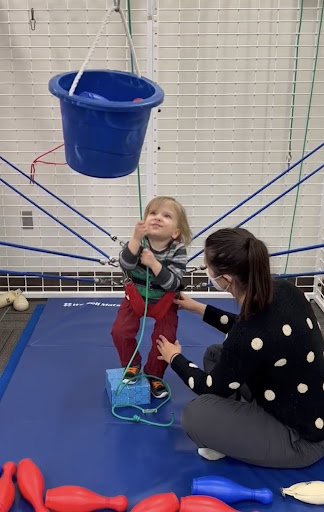
Typically, most of us move through daily life without consciously thinking about how we are moving our bodies. We can walk while daydreaming without bumping into a street sign, and we can sit in a chair without falling off while reading and writing. This may sound natural for many of us, but children with coordination deficits often use excessive energy, attention, and focus to fulfill all of the expectations they face each day. Through physical and occupational therapy we can help movement become automatic, letting children focus on higher level skills, whether it is moving through the classroom without bumping into things or learning algebra. That’s where we can help!
Addressing Misunderstandings and Building a Strong Foundation
Children with coordination disorders are often called lazy and told they’re not meeting their potential. People assume things will get better as the child gets older and that these are delays that will “catch up.”
In the meantime, the child struggles with their self-worth, self-esteem, and mental health. As we said before, research supports that children do not grow out of these struggles, and that children with coordination challenges are typically more sedentary adults with increased risk of cardiovascular and mental health problems.
Supporting a child’s ability to learn the skills they need in daily life is important, but we cannot fall into the work harder and try harder pit, without also working towards long-lasting change. We can help these children fill in those missing and weakened foundational skills. There are so many ways we can help these children meet their personal potential and protect their mental health, all at the same time.
Every day, children with developmental challenges are working incredibly hard. Let’s recognize and support their efforts by strengthening their foundation—just like building a house. By focusing on improving their building blocks, we help ensure they have the strongest foundation possible to support their growth and success.
Top 10 Tips for Parents of Children with DCD
- Martial arts and swimming are individual sports that help improve body awareness, sensory processing, and balance. They are sensory rich and can be modified for individual differences.
- Explore movement in fun, social, and noncompetitive ways, such as hiking, yoga, and creative movement.
- Identify postural imbalances that may be limiting the development of core strength and learn ways to improve postural symmetry..
- Provide supports for sitting if the child has difficulty sitting upright, such as a yoga wedge or a towel roll.
- Encourage the development of timing using music and movement opportunities.
- Adapt the environment for success. Some adaptations include picture schedules, written lists, and typing instead of writing.
- Practice listening, looking, and moving at the same time. Play walking and looking games, such as “I spy,” while going for a walk.
- Model the use of feedback during play. For example, if you throw a ball and it lands short of the basketball hoop, say “I threw it too soft.” Discuss what you could do differently, try it and discuss whether it was successful. Bring awareness to this process.
- Backward chaining is a way to learn how to complete a task by working backwards from completion. The child first does the last step to complete the task. Next, they would try the last two steps. The child can build this until they are independent with the entire task.
- Team up with a PT or OT specialist to work on the foundations of movement so that practice is more effective and successful!

Getting Help
If you see your child is working harder than other kids to get through their daily activities, don’t wait to look for help. You also don’t need an official diagnosis to get help. Reach out to us at Kid PT in Raritan, NJ and come in for a Discovery Visit. We will listen to your concerns, do a screening of your child and their movement skills, and help you make a plan. We’re here for you!
Start Your Child’s Journey To Success
Kid PT Is Helping Kids Move, Learn, And Thrive In Raritan, NJ And Central Jersey
Schedule Your Discovery Session
Take the first step by reaching out to our team. We’ll listen to your concerns, answer your questions, and guide you on how to begin.
Create A Plan
Work with our experienced therapists to develop a personalized plan that meets your child’s unique needs and sets achievable goals.
Watch Them Thrive
See your child gain skills, confidence, and independence as they reach milestones you once thought were out of reach.